
![]() |
![]() |
| Main Interview Page | ||||
Yami Bolo Deferred |
||||
| Interviewed by Gregory Stephens and Laura Gardner | 2/2/04 | |||
| Long
Beach, CA 2/20/00
|
||||
|
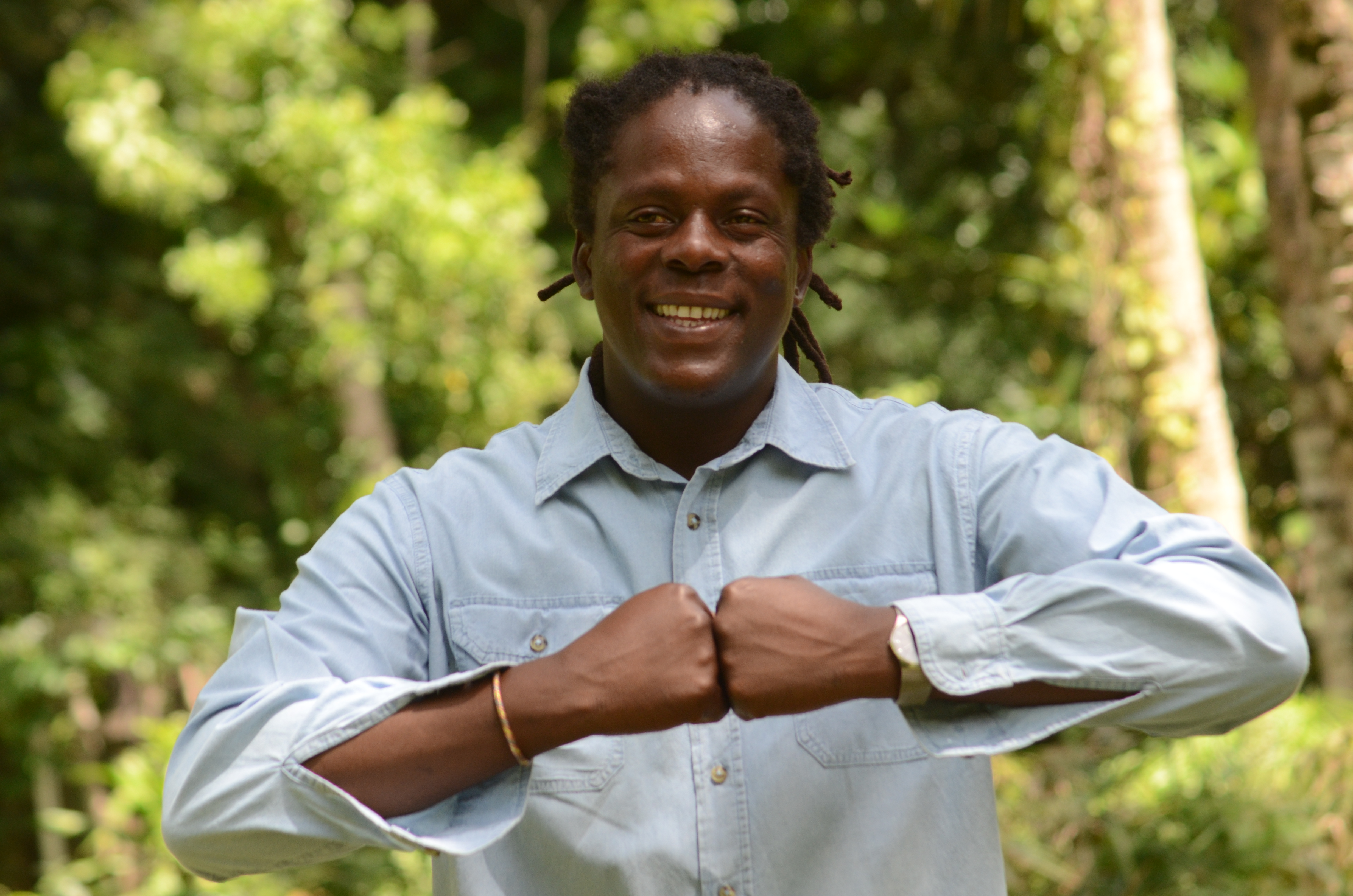
I have always felt a special affection for Yami Bolo, a culture singer born as Rolando McClean in 1970. He began recording for Sugar Minott’s Youth Promotion when he was barely a teen, so he has always seemed like a quintessential Jamaican “youth” to me. His 1992 set for Heartbeat, “Up Life Street,” foreshadowed the “Rasta Renaissance” of the mid-1990s. Boom shots like “Officials Are Like Locust” (on “Fighting for Peace,” 1994 RAS) and the classic duo with Capleton “Put Down Your Weapon” (on “Jah Love,” 1998 VP) were highlights of that revival. His voice, if a bit too similar to Michael Rose for some, carries a sweet vibe uniquely his own.
So when I was hanging “backstage”with Jahworks editor Laura Gardner at the 2000 Long Beach Bob Marley Days, and a dreadlocks promoter asked if we wanted to interview Yami, I jumped at the chance. We stood on a stairwell in the foyer, while a band played inside. This handsome man has a fresh aspect and exuded the sort of inner peace I expected. But I found it hard to break through his tendency to efface himself, and to defer all credit to Selassie. When asked about personal inspirations, Yami simply repeated, over and over, that all credit was due to Haile Selassie.
Laura and I have deferred publication of this interview for almost four years mostly because we were waiting for Yami to release his next major album. It was only when I did some research in preparation for this article that I discovered that Yami in fact has released two other albums since our 2000 interview, “Wonders & Sign” (T.P. Records 2000), and “Healing of All Nations,” backed by the Roots Radics band, released on a small Vermont-based label, Roots Foundation, in 2001. Both of those albums have been all but invisible in terms of airplay or reviews.
Yami released two albums apiece during the 1990s for Heartbeat, RAS, and VP. But after the 1998 release for VP, “Jah Love,” he seems to have all but fallen off the map. A project recorded with Sly and Robbie was delayed for several years and then released as “Freedom & Liberation” with little fanfare by Tabou in 1999.
There are lyrical moments that seem contemporary, such as the song “Safeguard,” which decries “governmental insanity” with its “crimes against humanity,” and repeats the refrain “We must safeguard our liberty.” True dat!
There is also a nice combination with Capleton, “Liberation.” There are moments of typically sweet Yami idealism, as in the combo with General Jah Mikey and Bunny Mystic, “Talk ‘bout Slavery.” Oh that we could follow Yami’s prescription to “conquer the enemy with humility/ through nobility.” The song “Accident,” which reportedly was livicated to Mumia Abu Jamal in memory of the late progressive Senator Paul Wellstone, rings true, if in somewhat melodramatic fashion: “a new dark age is begun maximum darkness stop it from happening”
But like many roots artists, Yami’s relentless repetition of praise songs to Selassie follows the same template of praise songs by fundamentalists Christians, or almost any other monotheistic religion. So when I hear Yami’s ideal, that “the sun and the moon bow down before HIM” (“Hail the Conquering Lion”), or yet one more assertion that Selassie is “Rastaman’s saviour/earth’s rightful ruler” (“Sanctify Yourself”), I begin to tune out. Televangelists also argue that the earth should bow down before their saviour, and the nation that they feel God has chosen to fulfill his destiny on this earth.
Respect due.
* * * * *
Gregory Stephens (GS): Yami, I knew you first under Sugar Minott. Can you tell a little bit about the experience and background of working with Sugar, the don of the rub-a-dub sound?
Yami Bolo: Well, I give thanks and praise to the Most High, Haile Selassie I, first and for all. Sugar Minott is the godfather. While under the tutelage of Sugar Minott, I met with Junior Delgado. Then Junior Delgado introduced me to Augustus Pablo. So it all started with Sugar Minott! While at Sugar Minott’s, I met Tenor Saw. One day Tenor Saw was recording for Winston Riley. [Saw] was doing “Ring the Alarm” song, and he told Winston Riley that I could sing. So, I did the song “When A Man’s In Love” for Winston Riley in 1985. That is how I came into the music business.
Laura
Gardner (LG): Who were/are some of your inspirations then and now? Yami: First, all inspiration comes from the Most High, Haile Selassie I. Musicians: Augustus Pablo, Jackie Mitoo, Earl “Chinna” Smith. All the greats: Bob Marley, Peter Tosh, Bunny Wailer, Michael Rose, Junior Reid. Even the amateurs inspire me as well.
GS: So what’s the essence of the Yami Bolo style?
Yami: The essence, the whole essence is just love, you know, mixed with roots and culture. Trying to uplift the people’s mind, free them from mental oppression with music.
LG: Did you grow up in Kingston?
Yami: I grew up in Kingston 13 called “Kidley” off Spanish Town Road in Kingston.
GS: What was it like being a youth in your neighborhood? Tell me a little bit about what sounds you heard, what games you played, what conflicts you had.
Yami: In my neighborhood, I grew up under the tutelage of my grandmother, who always insisted that we go to church and go to school. So, my grandmother acted as both a man and a woman. She kind of kept us a certain way out of trouble, you know? I think if it wasn’t for my grandmother, I might be mixed up or something. But she always tried to teach us that we must stay away from the bad things. But in my neighborhood where I grew up, crime was the order of the day. So any likkle youth could take up a gun or a knife. Even we fussed and fought just like any other kid, but to stay out of that, we still had to elevate our mind with music. So I give thanks knowing Haile Selassie I and music. Because music takes us to another heights, where we can observe anything that comes at us: that streetlight of music, a whole university. I give thanks for that.
LG: But a lot of the youth that came up at the same time that you did got involved in the really hardcore dancehall. And you’re singing more roots-inspired music. What made you go that way when so many of your contemporaries were going the other way?
Yami: Well, I was going to school when Marley died and in my mind, I was telling myself that I just want to hold the flag, you know?
GS: There are a lot of people saying that.
Yami: In my heart, I have the sincere vibes about trying to hold the flag. I don’t like competition or nothing, but just trying to keep the message going, likewise a Sizzla or an Anthony B or a Capleton. Everyone wants to hold up that vibe ‘cause you have all kinds of music. You have negative music and positive music. So we can keep that positive music going. Some people keep saying, the captain of the ship is dead, you know? So the ship cannot move and things like that. We have to give thanks for the younger youth who came and took the same tradition of the forefathers because they could have taken on to other ways, the eviler ways…
GS: Are you a Bobo?
GS: Well, as I travel the country talking to people about Rasta, everyone has a different definition of what is a Rasta. So, what’s your definition?
Yami: My definition of Rasta is the way you live. Rasta is a way of life--love. Love governs it. Rasta is associated with righteousness. Righteousness is the foundation of the Almighty. So anyone, whether you’re black or you’re white, you’re Japanese, any nation, once you deal with Rasta love, within that righteousness you will reach the heights which is esteemed for one by the Creator.
GS: I’ve seen critical comments from Luciano about some of the variations of Rasta being voiced by the Bobos. Is there a lot of talk about that in Jamaica or is that wing accepted as part of the Rastas?
Yami: Propaganda machines are strong tools; however, we must not try to build upon that. We must try to keep it positive and step away from any confusion that exists. It must be rooted out from the root. And then we must put forth love with overstanding and we will go ‘pon it.
GS: Then how do you feel about the Bobos? Do you feel like they’re putting out a message of positivity and understanding?
Yami: They are putting out a positive message, likewise are all the rest of the houses. Sometimes the truth offends because everyone does their thing a little different. As the prophet says, “Sometimes to tell the people the truth, sometimes you have to smile.” You see what I’m saying?
GS:
I’ve really been inspired by your powerful criticisms of the political
system. Can you tell me anything about where the inspiration for “Officials
Are Like Locusts” came from?
GS: But you’re a man who lives in this time, and as I live in this time, I grew up in the country and I’ve seen swarms of locusts sitting on a wall, going away.
Yami: Haile Selassie is the Almighty. He’s a man of then. He’s a man of now and a man of the future. Give thanks to all who have seen. They’re a blessing, you know? But we who have never seen are still unknown, the next power.
LG: What are some of the projects going on right now for you?
Yami: We have a new record coming out on BRG record label. The date is not really set as yet, but it should be in the stores pretty soon. And look out for the Yami “Duets.”
LG: Which artists accompany you?
Yami: Junior Delgado, Johnny Osbourne, Dennis Brown, Capleton, Jack Radics. I’m trying to get Luciano and Sizzla on it as well, you know? It’s going to be a great album.
GS: Do you have a favorite recording studio?
Yami: Mixing Lab… we have so many different studios in Jamaica! I love all of them. Ocho Rios: Grove Studio, I like Ziggy Marley’s studio (Tuff Gong). I like both Tuff Gongs. Tuff Gong up ‘pa yard and Tuff Gong down a yard! [laughs]. Ziggy, me and Steve did a song together, “Mr. Big Man.” It’s been a long time now since we worked on this song, like two or three years and it’s just coming out now, but it has been getting a lot of play on the radio now. Pretty soon it’ll be out on 7”.
GS: I’m going to ask you a question that people asked Bob Marley a lot in his lifetime. Like other peoples throughout history, the Rastas re-imagined God in their own image. Yet you come to a place like Los Angeles and it’s a very mixed audience, but it’s mostly people of European descent. So what is your feeling about that? The relationship with Selassie and the people from all over the world who come to the music?
Yami: [very matter of fact] Our God, Haile Selassie I, is an international God! If he was just a God for Ethiopia, and not a God in America and in Jamaica, then he wouldn’t be a God, you know? So, then ultimately in Japan as well, you have Rasta. In America you have Rasta. In Jamaica you have Rasta. Even in Iceland and Greenland, you have Rasta! But history and time will prove the accuracy, because in every family, He will take one. In every family on the planet earth (black, white, Chinese, Japanese), He will take one: the Almighty, Rastafari, Haile Selassie I. And we don’t fight names anymore. Everyone have a different way in how they see God. And if we do that, it’s going to cause confusion and sometimes vexation. We don’t want no confusion, so we just say, “Jah Rastafari.” If the next one say, “Allah,” we love him. If he say, “Jesus Christ,” we love him. We don’t come to fight no thing. Christ promised the earth that when he returned, he would have a new name. He wouldn’t name Yesus Christos, but he told them that, “I will have a new name.”
GS: Can someone be a Rasta if they don’t believe Haile Selassie was God?
Yami: First, to be a Christian, you have to believe that Jesus Christ is our lord and our savior.
GS: Well some Christians believe that God reappears in different prophets over time.
Yami: As I say, that’s religion we’re getting into now. And when we get into religion, it is conflict, you know? So it is best to sometimes leave it where it stays. Like Rastafari, Jesus Christ, bless.
GS: Everybody gets a different vibe off of Rastafari around the world. Can you tell me how “Put Down You Weapon” came together? It’s a favorite song of mine.
Yami: A long time ago, me and Capleton fi really collaborate on something. So it was producer’s Bulby’s idea who brought us together. And we just do it like one take. It’s like a historical thing, because all the rest of the songs I did, I had to do it over and over and over and over, but with “Put Down the Weapon,” it was like one take. And I said, “That’s it!” and him say, “Yeah, that’s it!” It stands out in my mind as the song that was a one take song, you know?
GS: What do most youth in Jamaica listen to now? Do they listen to hip-hop and R&B as well as dancehall?
Yami: I think the youths are seeing their culture; however, as I say, variety is the spice of life, so everyone wants to listen a little hip-hop, a little love, a little jazz. Them youths come in and they have no boundaries or barriers. You can’t hold them. So them youth just coming up with a bag of love. And if you don’t teach them right, they’ll just come up with a bag of hate. So it is us, now, as the parents, to teach the children in the way that they should grow up. So when they grow big, they don’t depart from the right and the love.
GS: Rasta music has been a moral compass for me for a very long time. When I look at, say, hip-hop in the US, and I try to find that same moral authority that I hear in Rastafarian-influenced music, I don’t find it. Do you have any feelings about this sort of guidance that popular music is giving or not giving American youth?
Yami: Righteousness exalt the nation so sinners are reproached. If we promote sex, then they’re just going to think sex. If you promote righteousness, then they think righteousness. It’s what we promote. In America, they promote sex more than righteousness. Everywhere you go you see sex sells, so they promote sex, rock’n’roll and drink. So you have a nation of that. The youths them need more than that. We don’t want the youths to come drinking and smoking and all of that. We need a generation of scientists and teachers, nurses. Good lives and doctors.
GS: Well, we’re still graduating thieves and murderers here.
Yami: Okay. What is loose on earth is loose in heaven, you know? So we haffi have some balance.
GS: Have you heard “Chant Down Babylon,” Stephen Marley’s album?
Yami: Yes.
GS: What do you think of that?
Yami: It’s a great project and I congratulate Steve very much for upholding his father’s legacy. Because sometimes when one father trods through another heights, people tend to forget the vision. However, it’s not that way with Stephen. Stephen is always consistent on the vision and I appreciate him for that.
LG: Do you think it’s going to get to the people who wouldn’t normally listen to Bob Marley because of the collaborations with hip-hop artists?
Yami: I don’t think. I know. It WILL get to the people in the passage of time because it’s a music, it’s a vehicle, it’s a message and it will get to the right people at the right time. Yes.
GS: I’ve heard Rastas described as a community of prophets. Do you see yourself in the culture in that way?
Yami: Well, we see ourself as humble person, sending out a message of humility, urging the governments to heed to the call of the Most High, with justice for the people being oppressed mentally, economically and spiritually.
GS: That’s a part of Rasta that we hear all of the time, “Humble yourself, my brother.” But at the same time, it’s prophesy fulfill, right?
Yami: The prophecy will always fulfill because this is modern day slavery with modern fears. The system exists then and it exists now.
GS: Modern day slavery?
Yami: Yes, and we have modern theorists, so father have to say ‘modern Moses.’ Moses as returned dreadlock.
GS: There it is! That’s a yes, I think [laughs]. I want to thank you for coming here and sharing the spirit and I love your voice. You’re a joy. Any advice you want to leave with the people in the Bay Area who read this?
Yami: I just want to say, give thanks and praises to the Most High, Haile Selassie I for bestowing of the knowledge of history and I’n’I’n’I’n’I’n’I…Teach love to the children, so that when they grow big, they won’t depart. Peace.
LG: Will you be coming up to Northern California soon?
Yami: Anywhere the Father send us, we will go, because it’s the Father’s work, it’s not our work. The Father will always keep attacking Babylon, you know?
YAMI BOLO DISCOGRAPHY
Ransom, Shanachie 1990
He Who Feels It Knows It, Heartbeat 1991
Up Life Street, Heartbeat 1992
Fighting for Peace, RAS 1994
Born Again, RAS 1996
Star of Love, VP 1997
Jah Love, VP 1998
Freedom & Liberation, Tabou 1999 (Sly & Robbie)
Say A Prayer, Imaj 1999
Wonders & Sign, T.P. Records 2000
Healing of All Nations, Roots Foundation 2001 (Roots Radics)
Gregory Stephens is the author
of "On Racial Frontiers: The New Culture of Frederick Douglass, Ralph
Ellison, and Bob Marley" (Cambridge UP). His current book-in-progress
is "Real Revolutionaries," excerpts of which can be found on
his website. A former Lecturer
at the University of California and a Rockefeller Fellow at the University
of North Carolina, he is currently a Bilingual Teacher in Oklahoma City
Public Schools. Contact gstephen@email.unc.edu.
Gregory's interview with JahWorks.org editor Laura Gardner is here. |
||||
|
page 1 of 1 |
||||
|
|